

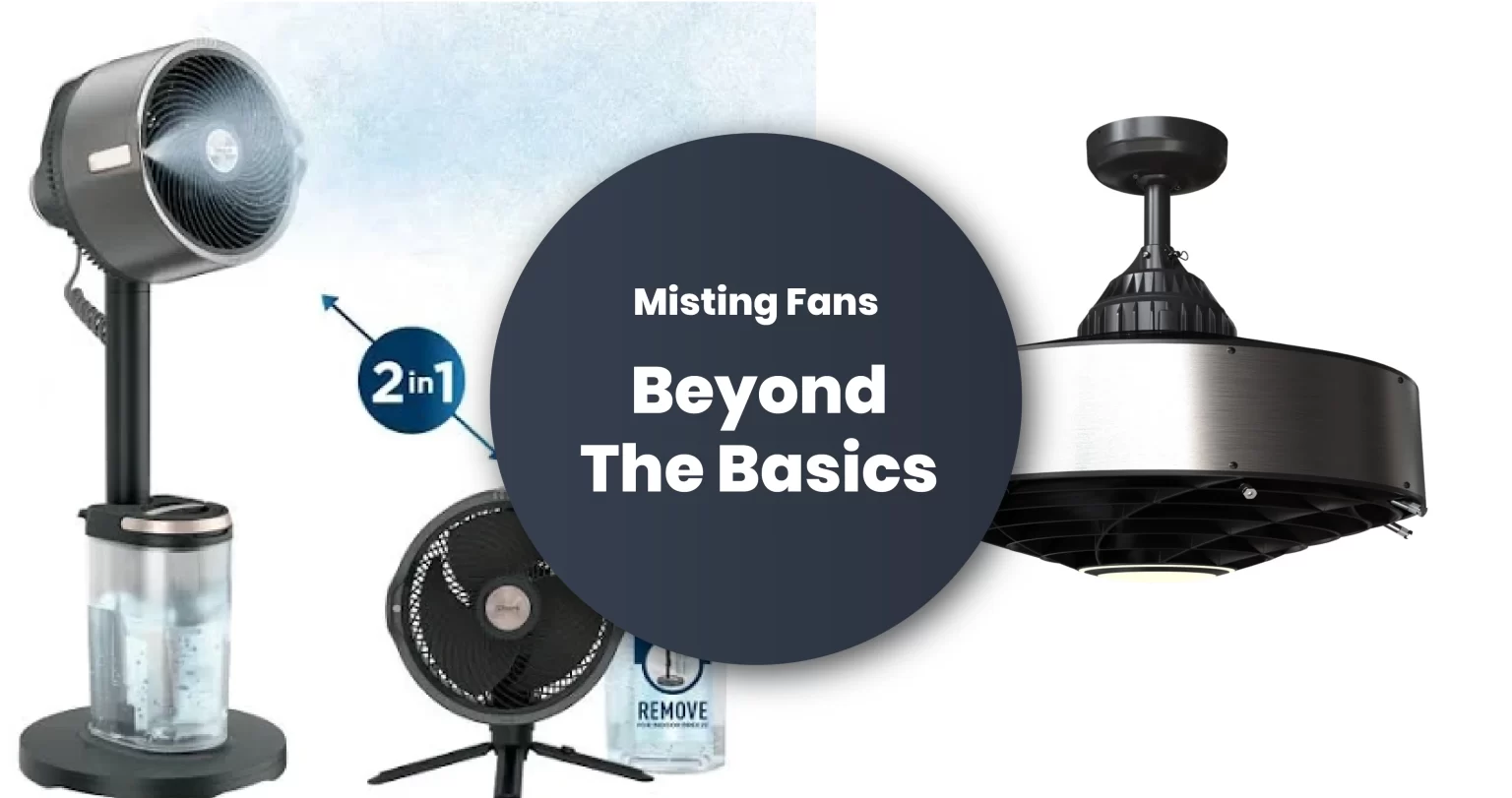
Staying cool on a hot day is a universal need, and “misting fans” have surged in popularity for one simple reason: they combine air movement with a fine spray of water to deliver refreshing relief. But before you click “buy” on the first desktop gadget or blow thousands on an overhead unit, it’s worth understanding that there are smarter, more adaptable choices out there. In this post, we’ll explore:
- When a misting fan is the right choice
- The types of products that fall under the “misting fans” umbrella
- The pros and cons of desktop, overhead, and inline systems
- How to decide which one suits your needs best
Whether you’re after a budget-friendly desktop fan or a whole-zone option, we’ve got you covered.
When Is It the Right Time to Buy a Misting Fan?
If you’re questioning whether a misting fan is the right solution for your cooling needs, here are some telltale signs you’re a good match:
- You need fast, personal cooling. When you’re working at your desk, relaxing on the patio, or lounging poolside, you want relief ASAP. A misting fan delivers a hit of cool air right when you need it—without waiting for house-wide AC to catch up.
- You want a portable, instant solution. Unlike air conditioners or permanent fixtures, many misting fans are portable. They’re easy to move, plug in, and start using within seconds. Your relief doesn’t have to wait.
- You’re in a dry, arid climate. Arizona, parts of the Southwest, and other desert regions—if that’s you, a misting fan can feel like magic. Water evaporates quickly in dry air, and the cooling effect is amplified.
- You don’t want to install or maintain complex equipment. Small, consumer-style misting fans need minimal maintenance. Refill the reservoir or snap in a cartridge every so often, and you’re good to go. No plumbing, no contractor needed.
- You’re focused on a specific spot—not the whole property. A misting fan is great for cooling a picnic table, sun deck, workout spot, or workstation. But if your goal is widespread, whole-area cooling, you may want more.
If any of the above match your situation, a misting fan is probably a great idea.
But here’s the thing: not all misting fans are made equal.
Misting Fans: Types, Pros & Cons
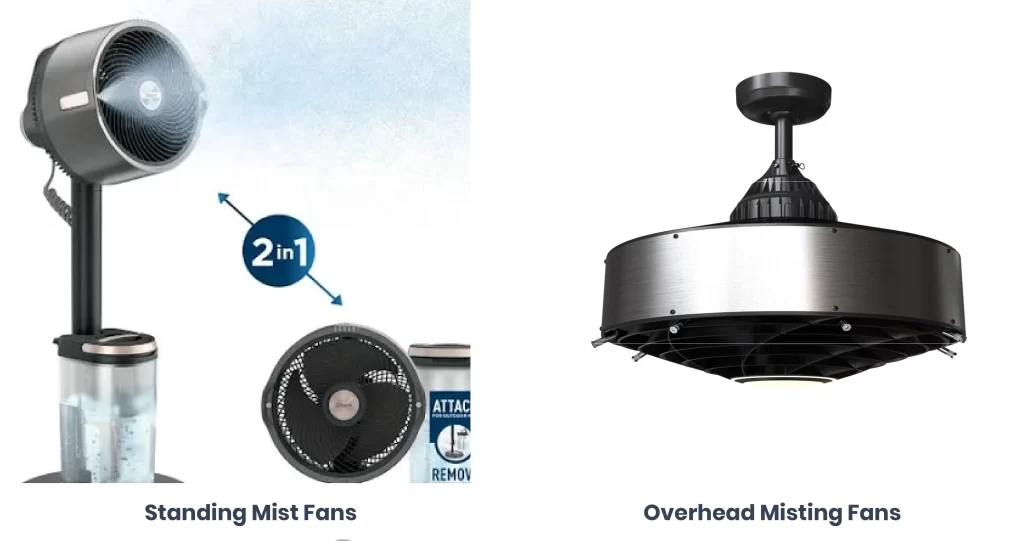
Let’s break down the three main types of misting fans people typically compare:
1. Desktop or Budget Mist Units
What they are: Small, affordable fans with a built-in water reservoir or mist cartridge. Often inexpensive and widely available.
Pros:
- Ultra-affordable (often under $50)
- Portable and plug-and-play
- Great for targeted relief (desk, bedside, patio chair)
Cons:
- Limited runtime per refill
- Modest airflow and mist coverage
- Water reservoir may require frequent refills
- Usually not built for outdoor elements (dust, sun damage)
2. Overhead Misting Fans (Like Aeromist’s)
What they are: Large ceiling- or overhead-mounted fans that spray mist over wider areas. These require water lines and often professional installation.
Pros:
- Broad coverage across patios, decks, outdoor kitchens
- Powerful fans combined with continuous mist
- Excellent for entertaining or covering large spaces
Cons:
- High upfront cost—including installation
- Requires plumbing, possibly site modifications
- Permanent and not easily relocated
- Regular maintenance needed (nozzles can clog, lines must be winterized)
3. Inline Misting Systems (The “Hidden” Middle Option)
What they are: These systems integrate a powerful fan with an inline misting pump or cartridge system. Compact and self-contained, but more robust than a simple desktop unit.
Pros:
- Delivers sustained, high-pressure mist for better evaporation
- Cleaner setup—no hanging piping, unsightly hoses, or reservoir buckets
- Ideal for places like RVs, screened porches, or compact outdoor areas
- Often DIY-installable—no major contracting required
Cons:
- More expensive than an entry-level desktop unit
- Requires some setup: mounting and a basic water connection
- Still not as extensive in coverage as fully installed overhead systems
- Maintenance may include replacing filters or cartridges periodically
Comparing Your Options at a Glance
| Use Case | Best Option | Why It Fits |
|---|---|---|
| Budget-friendly personal cooling | Desktop misting fan | Inexpensive, plug-and-play, spot relief |
| Large patio or entertaining space | Overhead misting fan | High airflow + wide mist coverage; perfect for big open zones |
| Sleek, mid-range DIY solution | Inline misting system | Balanced cost/coverage, clean appearance, sustained misting without hoses |
| Need to move or store easily | Desktop misting fan | Lightweight, portable, no installation required |
| Want hidden, low-profile setup | Inline misting system | Entire operation is mostly hidden—tubes concealed, components compact |
How to Decide: Is It Time for a Misting Fan — and Which One?
Step 1: Define Your Cooling Goal
- Do you just want to cool yourself or a couple of people? → A desktop misting fan may be sufficient.
- Is it a large area like a full porch or patio? → Consider an overhead misting fan.
- Want something that’s unobtrusive, less obvious, but still powerful? → Look closely at an inline misting system.
Step 2: Evaluate Your Space & Setup
- Do you have a nearby water source or are you okay with refilling by hand?
- Can you run a hose or water line, or do you prefer a unit that hides everything seamlessly?
- Are you open to mounting fans or do you want something that stays ground-level and easily removable?
Step 3: Set a Budget & Long-Term Perspective
- Desktop units are low-cost but may wear out faster.
- Overhead systems are expensive to install but offer premium coverage.
- Inline systems land in between—more upfront cost than desktop, but more elegant and effective; less costly and intrusive than overhead.
Step 4: Think About Maintenance & Longevity
- Do you want minimal upkeep? Desktop units are simplest.
- Are you okay with seasonal maintenance like winterizing pipes or cleaning nozzles? Overhead units need it.
- Prefer streamlined components and occasional filter swaps? Inline systems strike a reasonable balance.
Conclusion: Choosing the Right Time and Type of Misting Fan
When you catch yourself thinking “I could really use a misting fan right now,” that’s your sign to explore your options. Don’t settle for buying the cheapest desktop fan just because it’s tempting — know that there are better solutions depending on your needs:
- Desktop misting fans are perfect for cheap, immediate relief in small spaces.
- Overhead misting fans are ideal for large-area, long-term outdoor comfort—if you’re ready to spend and install responsibly.
- Inline misting systems offer a hidden, powerful, and versatile middle ground that many homeowners and renters will appreciate.
By asking the right questions about space, mobility, coverage, and cost, you can choose the misting fan option that feels smart—not just cool.
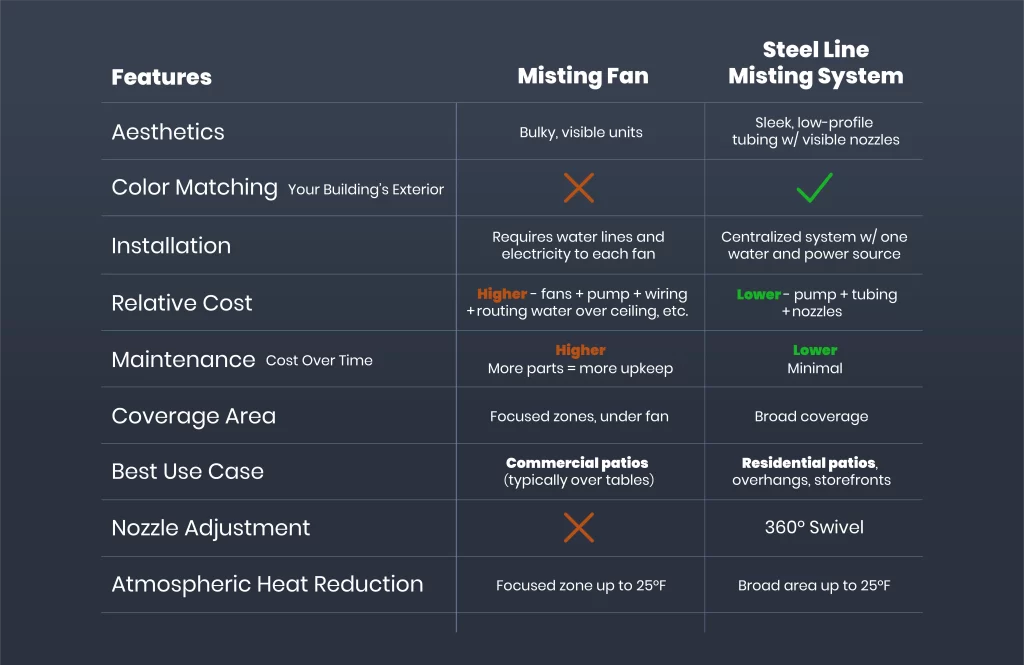
Quick Comparison: Misting Fans vs. Steel Line Systems
Next time, you might explore topics like “How effective is evaporative cooling with misting fans compared to traditional fans?” or “Maintenance tips for keeping your misting system clean and clog-free.” In the meantime, here’s hoping your summer is cool, breezy, and misted just right.
Let me know if you’d like help with images, SEO-focused keywords, or real-world comparisons between brands—you’ve got this!